
- All
- Product Name
- Product Keyword
- Product Model
- Product Summary
- Product Description
- Multi Field Search


Views: 0 Author: Site Editor Publish Time: 2026-10-14 Origin: Site


Engineers frequently specify helical gears for their quiet and smooth power transmission. The angled teeth engage gradually. This reduces shock loads and minimizes vibration. However, this specific geometry introduces a significant mechanical challenge. When the angled teeth mesh, they do not just push against each other in the direction of rotation. They also generate a lateral force pushing along the axis of the gear shaft. This phenomenon is known as axial thrust.
Managing this end thrust requires careful engineering. If a system relies on standard radial bearings, the lateral forces will cause premature bearing failure. The shaft may deflect. The gear alignment will suffer. To counteract this, designers must incorporate robust thrust bearings into the equipment architecture. Finding a reliable Helical Gear Reducer means looking for a design that already accounts for these internal forces through superior bearing selection and housing integrity.
Adding thrust bearings directly impacts the overall design of the machinery. These specialized bearings take up additional physical space. Consequently, the gearbox housing must be cast larger and stronger to accommodate them and absorb the lateral loads. This increases the overall footprint of the drive system.
Furthermore, manufacturing the angled teeth requires high-precision machining and advanced gear hobbing techniques. The complex geometry demands tighter tolerances during production compared to straight-cut gears. This elevated manufacturing complexity naturally translates to higher initial production costs. Plant managers must weigh this upfront investment against the long-term benefits of reduced noise and smoother operation.
The meshing action of helical gears involves a higher degree of sliding contact between the gear teeth. In contrast, straight-cut gears rely more on rolling contact. Sliding friction inherently generates more heat. As a result, the system experiences a slight drop in mechanical efficiency. Maintaining optimal Gear Efficiency becomes a critical focus during continuous heavy-duty operation.
To dissipate this excess heat, the drivetrain often requires higher-grade synthetic lubricants. In extreme industrial applications, external cooling systems or oil coolers might be necessary to maintain proper operating temperatures. This adds another layer of complexity to maintenance schedules and fluid management.
Current industrial automation and heavy manufacturing sectors are pushing heavily toward ultra-compact, high-efficiency drivetrains. Machine builders want smaller equipment footprints without sacrificing torque. This trend directly challenges the traditional drawbacks of helical configurations, specifically the bulky thrust bearing arrangements required to manage axial loads.
To adapt, leading gear manufacturers are investing in advanced metallurgy and precision micro-geometry modifications. By optimizing the helix angle, engineers can find the perfect middle ground. A carefully calculated angle reduces the axial thrust to manageable levels while still preserving the acoustic benefits of the helical mesh. This evolution is particularly crucial in sectors like mining, logistics, and bulk material handling, where equipment must be both extremely durable and spatially efficient.
Understanding the exact differences helps in making precise equipment choices. Below is a direct comparison evaluating the mechanical realities of both designs.
| Engineering Parameter | Helical Gears | Spur Gears |
|---|---|---|
| Axial Thrust Force | High, requires thrust bearings | Zero, uses standard radial bearings |
| Operational Noise | Very low, smooth gradual meshing | High, prone to vibration at high speeds |
| Load Capacity | High, multiple teeth share the load | Moderate, single tooth bears the load |
| Manufacturing Cost | Higher due to complex tooth geometry | Lower, simpler machining process |
| Efficiency | Slightly lower due to sliding friction | Very high, mostly rolling friction |
Abstract theories mean little on the factory floor. When selecting a Parallel Shaft Gearbox, you must look at how the manufacturer mitigates these inherent disadvantages. The key lies in structural rigidity and precise angle optimization.
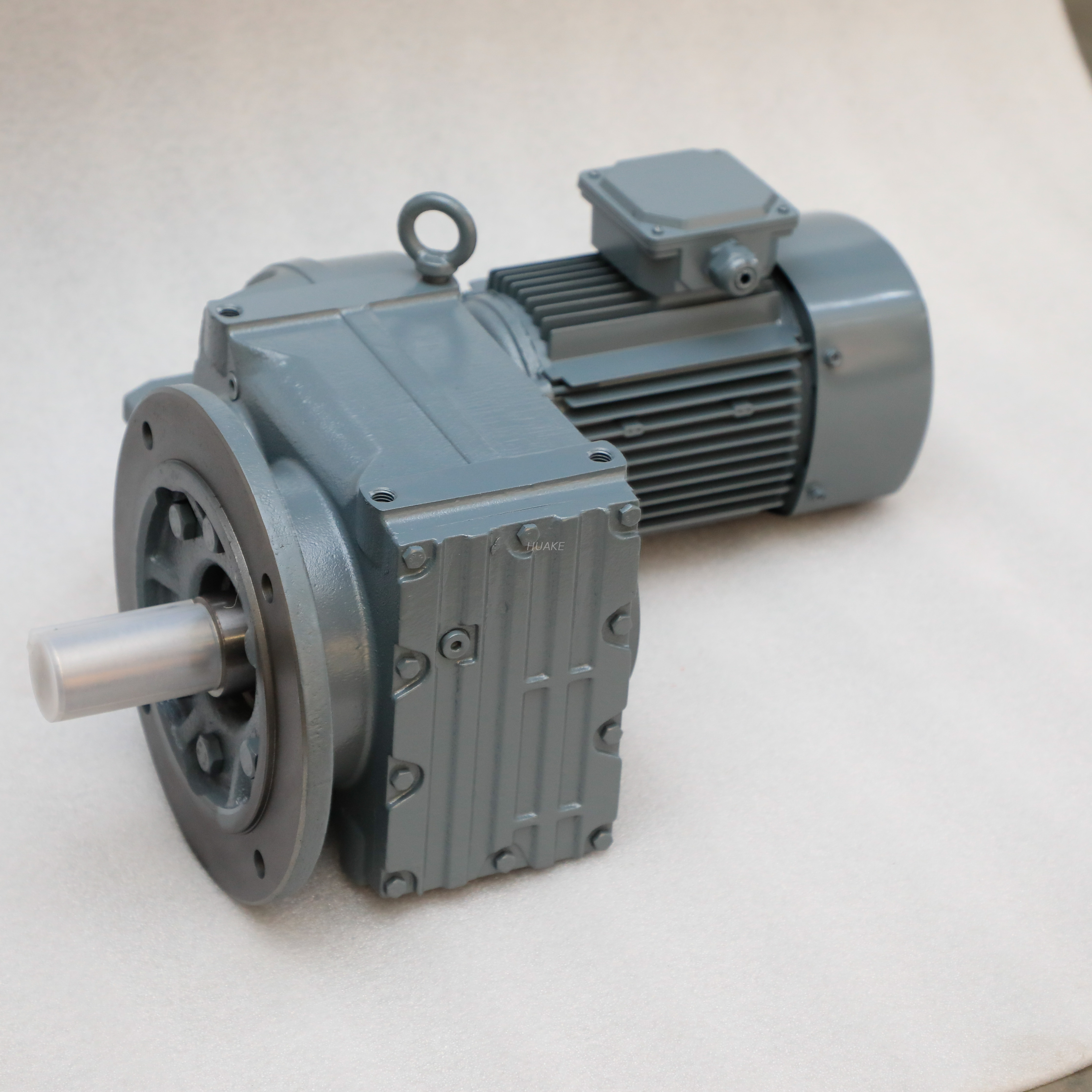
Specifically, look for drive units designed for heavy-duty conveying systems. The F-Series Industrial Parallel Shaft Helical Gear Reducer from Huake serves as a prime example of overcoming these mechanical hurdles. Instead of using standard angles, Huake optimizes the helix angle to minimize sliding friction while maintaining exceptional load distribution. The housing is cast to absorb residual axial forces effortlessly.
When evaluating a Helical Gear Motor for your facility, check the actual performance parameters. The Huake F-Series delivers an output speed ranging from 0.1 to 752 rpm and supports motor power up to 200 kW. Most importantly, the robust bearing configuration allows it to output up to 18,000 Nm of torque. These specifications demonstrate that with the right internal engineering, the disadvantages of axial thrust and heat generation can be completely neutralized, leaving you with a highly reliable, quiet power transmission system.
The angled teeth of these gears create a wedging action during rotation. This action generates a lateral force that pushes the gear along the shaft. Standard radial bearings are designed to support weight perpendicular to the shaft, not parallel to it. Therefore, thrust bearings must be installed to absorb this specific lateral load and keep the shaft perfectly aligned.
Yes, but usually by a very small margin. The angled teeth experience more sliding contact as they engage and disengage, which generates slightly more friction and heat compared to the rolling contact of spur gears. However, in high-quality industrial gearboxes, proper lubrication and precision machining make this efficiency loss almost negligible.
A double helical gear features two sets of angled teeth cut in opposite directions on the same gear blank. When the gear operates, the axial thrust generated by one set of teeth is entirely canceled out by the equal and opposite thrust generated by the other set. This eliminates the need for heavy thrust bearings while maintaining smooth operation.
Every mechanical design involves trade-offs. The axial thrust, complex manufacturing, and slight friction increases associated with angled gear teeth are real engineering challenges. However, these factors only become true disadvantages if the equipment is poorly designed or improperly specified for the application.
By choosing a well-engineered Industrial Reducer, you bypass these issues entirely. Advanced housing designs and optimized bearing setups transform potential weaknesses into reliable, long-lasting performance. If your facility requires quiet, high-torque power transmission without the headache of premature bearing failure, evaluate your specific load requirements carefully. Explore the robust F-Series and other optimized drive solutions at Huake to find the exact configuration that aligns with your operational demands.


