
- All
- Product Name
- Product Keyword
- Product Model
- Product Summary
- Product Description
- Multi Field Search


Views: 0 Author: Site Editor Publish Time: 2026-08-07 Origin: Site


Many industrial machines do not operate for only a few minutes at a time. Conveyors, pumps, mixers, packaging lines, crushers, extruders and processing equipment may run for long shifts or near-continuous production cycles. In these conditions, the gear reducer must transmit torque steadily while managing heat, lubrication, bearing load, vibration and wear.
A helical gear reducer is often selected for continuous-duty applications because of its smooth tooth engagement, high transmission efficiency and stable torque output. Compared with gear designs that rely on more abrupt tooth contact or higher sliding friction, a helical gearbox can distribute load more smoothly across the gear teeth. This helps reduce vibration and supports more reliable long-term operation.
However, continuous duty does not mean that any reducer can run endlessly without correct selection or maintenance. A reducer used in continuous operation must be properly matched to torque demand, reduction ratio, input speed, mounting position, service factor, lubrication method, ambient temperature and load conditions.
For continuous-duty industrial applications, HUAKE’s Helical Gear Reducers provide efficient, durable and customizable transmission solutions for different mounting layouts and working conditions.
This article explains how a helical gear reducer handles continuous duty and what buyers should check before selecting one for long-hour industrial operation.
A helical gear reducer handles continuous duty by combining smooth gear meshing, efficient torque transmission, strong gear tooth design, proper bearing support, stable lubrication and effective thermal management.
Key points include:
Continuous duty creates ongoing heat, gear mesh load and bearing load.
Helical gears engage gradually, reducing shock and vibration.
Higher transmission efficiency helps limit unnecessary heat generation.
Hardened gear teeth improve wear resistance under repeated loading.
Lubrication protects gear surfaces and bearings during long operation.
Housing rigidity helps maintain shaft alignment and gear contact accuracy.
Correct service factor selection protects the reducer from overload.
Continuous-duty applications require proper installation and maintenance.
In short, a helical gearbox can support continuous operation when it is correctly sized, properly lubricated and used within suitable load and environmental conditions.
Continuous duty means that a gear reducer operates for long periods with limited stop time. It may run for one full shift, multiple shifts or continuous production depending on the equipment. The reducer must keep transmitting torque while managing heat buildup, lubrication stress, bearing load and repeated gear tooth contact.
Continuous duty is different from intermittent duty. In intermittent operation, the reducer has more time to cool down between cycles. In continuous operation, heat and mechanical stress accumulate over time. If the reducer is undersized or poorly lubricated, the risk of wear, overheating and failure increases.
Continuous duty is common in:
Conveyor systems
Pumps
Mixers and agitators
Packaging lines
Mining and material handling equipment
Rubber and plastic machinery
Food processing machinery
Chemical processing equipment
Textile machinery
Cement and construction material equipment
For these applications, the gear reducer must not only provide the required output speed and torque. It must also remain stable over long working hours.
A helical gear reducer is well suited for continuous-duty operation because of the way its gear teeth engage. Helical gears have angled teeth. Instead of contacting all at once, the teeth engage gradually. This creates smoother power transmission and helps reduce impact between gear teeth.
The angled tooth profile allows gradual engagement between gears. This reduces sudden impact and improves running smoothness. For equipment that operates continuously, lower vibration can help protect bearings, shafts, seals and connected machinery.
Helical gear reducers generally provide efficient torque transmission. Higher efficiency means less power is lost as heat. In continuous-duty applications, this matters because excess heat can affect lubricant performance, seals and bearing life.
Because multiple teeth may share load during operation, a helical gearbox can distribute force more smoothly across the gear mesh. This helps improve load-carrying performance and reduces localized stress.
Smooth meshing reduces vibration and operating noise. This is useful for packaging machinery, food processing equipment, pumps, conveyors and production lines where stable motion is important.
A properly selected helical gear reducer can handle steady torque loads and moderate shock loads. For heavy-duty operation, reducer selection should include service factor, output torque, starting load and environmental conditions.
Continuous operation places long-term stress on mechanical transmission systems. Even a high-quality reducer can fail early if the application conditions are not considered.
Heat is one of the main risks in continuous duty. Gear meshing, bearings and lubricant movement all generate heat. If the reducer cannot dissipate heat properly, oil temperature may rise and reduce lubrication performance.
Lubrication protects gear teeth and bearings. During continuous operation, oil must maintain a stable film between moving surfaces. If the oil level is too low, viscosity is incorrect or oil is contaminated, wear may increase quickly.
Bearings support shafts and help maintain gear alignment. Continuous radial and axial loads can create fatigue over time. Incorrect reducer selection or poor alignment can increase bearing stress.
Repeated gear contact can cause wear, pitting or surface fatigue. Hardened gear teeth, accurate machining and proper lubrication help reduce this risk.
Some machines do not run under perfectly steady load. Mixers, crushers, conveyors with uneven material flow and heavy equipment may create shock loads. A reducer used in these applications needs enough torque margin and service factor.
Dust, moisture, chemicals and high humidity can enter the reducer if seals are damaged or poorly selected. Contamination can degrade oil and increase wear.
Continuous Motor Input
        ↓
Repeated Torque Transmission
        ↓
Gear Mesh Load and Bearing Load
        ↓
Heat Generation and Lubrication Stress
        ↓
Thermal Dissipation and Oil Film Protection
        ↓
Stable Output Torque
        ↓
Long-Term Continuous Operation
This process shows why continuous duty must be considered as a complete system issue. Gear design, lubrication, bearings, housing, heat control and maintenance all affect final reliability.
A helical gear reducer handles continuous duty through several design and selection factors.
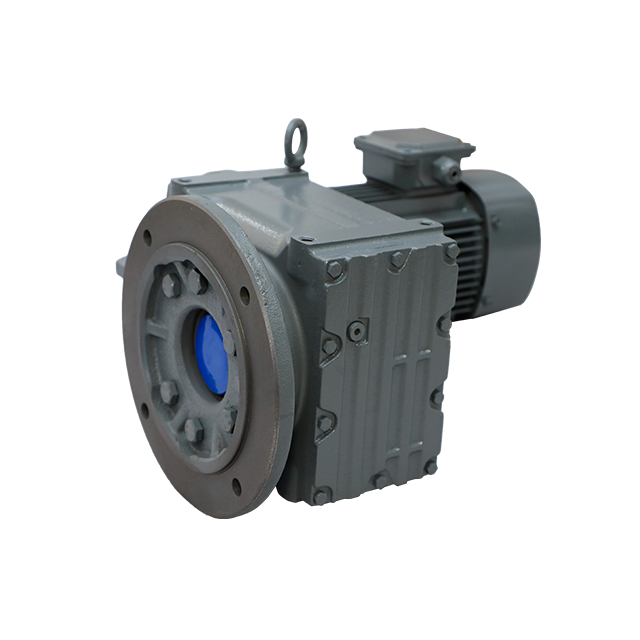
Hardened gears improve surface strength and wear resistance. In continuous operation, gear teeth contact repeatedly for long hours. Strong gear surfaces help resist pitting, wear and fatigue.
The housing supports internal shafts, gears and bearings. A rigid housing helps maintain correct alignment under load. Good alignment is important because misalignment can cause uneven gear tooth contact and bearing stress.
Bearings must support both radial and axial forces. Since helical gears generate axial thrust because of their angled teeth, bearing selection is important. Proper support helps maintain shaft stability during continuous torque transmission.
Many helical gear reducers use oil bath lubrication. For higher power, higher speed or heavy-duty conditions, forced lubrication or additional cooling may be needed. The correct lubrication method helps protect gears and bearings during long operation.
Continuous operation generates heat. A well-designed reducer housing helps dissipate heat. In demanding conditions, users may need to consider oil cooling, fan cooling or installation space with proper ventilation.
Service factor is a key part of gear reducer selection. It accounts for operating hours, load type, starts and stops, shock load and application severity. A reducer selected with the correct service factor has better safety margin for continuous-duty operation.
| Continuous Duty Risk | Reducer Design Response |
|---|---|
| Heat buildup | Efficient gear mesh and housing heat dissipation |
| Oil film breakdown | Correct lubricant viscosity and oil level |
| Gear tooth wear | Hardened gear teeth and accurate gear profile |
| Bearing fatigue | Proper bearing selection and shaft support |
| Shock load | Correct service factor and torque margin |
| Vibration | Smooth helical tooth engagement |
| Shaft misalignment | Rigid housing and accurate assembly |
| Contamination | Reliable seals and maintenance inspection |
| High ambient temperature | Cooling allowance and suitable lubricant |
| Long operating hours | Proper sizing and scheduled maintenance |
Helical gear reducers are used in many industries where equipment must run for long periods. The application type affects reducer selection.
Conveyors often run continuously with steady or variable load. A helical gear reducer can provide stable torque and reliable speed reduction for belt conveyors, roller conveyors and material handling systems.
For conveyor systems and parallel shaft transmission layouts, the F Series Parallel Shaft Helical Gear Reducer can be considered when stable torque transmission and compact installation are required.
Pumps usually require continuous rotation and efficient torque transmission. Mixers may create variable load, especially when viscosity changes or material resistance increases. Reducer selection should consider torque margin and load fluctuation.
Packaging machinery often requires smooth motion, low vibration and stable speed. A helical gearbox can support continuous production with lower noise and consistent output.
Mining, crushing and bulk material handling often involve heavy load, dust and shock. Reducers used in these environments require stronger housing, reliable sealing, suitable service factor and careful maintenance.
Extruders, calenders and related equipment may operate continuously under high torque. Gear reducer selection should focus on output torque, thermal behavior, lubrication and load stability.
Chemical mixers, agitators and processing lines may run continuously in challenging environments. Users should consider sealing, lubrication, corrosion risk and maintenance access.
| Application | Continuous Duty Requirement | Reducer Selection Focus |
|---|---|---|
| Conveyor systems | Long running hours and steady load | Torque, service factor, mounting position |
| Pumps | Continuous rotation and stable output | Efficiency, heat control, shaft alignment |
| Mixers | Variable load and starting torque | Torque margin and shock load resistance |
| Packaging lines | Smooth and low-noise operation | Precision, low vibration, compact layout |
| Mining equipment | Heavy load and harsh environment | Housing strength, bearings, seals |
| Rubber machinery | Long operation under high torque | Lubrication, thermal control, torque capacity |
| Chemical equipment | Continuous operation and corrosion risk | Sealing, lubricant, environment protection |
| Food machinery | Clean operation and steady output | Noise control, reliability, maintenance access |
A helical gear reducer is often compared with worm gear reducers, bevel gear reducers and planetary gear reducers. Each type has its own advantages, but helical gearboxes are commonly selected when users need high efficiency, smooth operation and reliable torque transmission.
Worm gear reducers are compact and can provide large reduction ratios, but they may generate more heat because of sliding friction. Planetary gear reducers are compact and high precision, but they may not always be the best choice for large industrial layouts. Bevel gear reducers are useful for right-angle transmission.
If you are still comparing reducer types, HUAKE’s guide on Worm Gear Reducer vs Helical Gearbox explains why helical gearboxes are often preferred for higher efficiency and continuous-duty applications.
For continuous-duty industrial equipment, helical gear reducers are often selected because they balance efficiency, load capacity, durability and installation flexibility.
Selecting a helical gear reducer for continuous duty requires a complete review of operating conditions. The reducer should not be selected only by motor power or ratio.
Output torque must meet the actual load requirement. Users should calculate both normal operating torque and peak torque. If the reducer is undersized, gear wear and overheating may occur.
The reduction ratio determines output speed. It should match the required machine speed and motor input speed. Incorrect ratio selection can reduce efficiency or overload the reducer.
The motor speed and reducer input speed must match the reducer rating. High input speed can increase heat and lubrication demand.
A steady conveyor load is different from a mixer, crusher or intermittent shock load. Load type affects service factor and torque margin.
Service factor accounts for operating hours, load characteristics, starts and stops, shock load and environmental severity. Continuous-duty applications usually require careful service factor selection.
Mounting position affects lubrication and installation layout. Horizontal, vertical, flange-mounted and shaft-mounted installations may require different oil levels or reducer configurations.
Check lubricant type, oil level, oil change interval and cooling requirement. For high-power or high-temperature applications, additional thermal control may be needed.
Dust, humidity, outdoor exposure, chemicals, washdown conditions and ambient temperature can affect seals, lubricant and housing protection.
Continuous-duty machines should allow convenient inspection, oil change and seal replacement. Poor maintenance access can increase downtime.
| Factor | What to Check |
|---|---|
| Output torque | Required torque under normal and peak load |
| Reduction ratio | Required output speed |
| Input speed | Motor speed and reducer rating |
| Load type | Steady, variable, shock, or heavy load |
| Service factor | Operating hours, starts/stops, load severity |
| Mounting position | Horizontal, vertical, flange-mounted, shaft-mounted |
| Lubrication | Oil type, oil level, oil change interval |
| Cooling | Natural cooling, fan cooling, or oil cooling |
| Environment | Dust, humidity, temperature, chemicals |
| Housing strength | Load support and installation rigidity |
| Bearing support | Radial and axial load capacity |
| Sealing | Contamination and leakage control |
| Maintenance access | Inspection, oil change, bearing and seal checks |
HUAKE provides helical gear reducer solutions for industrial transmission applications. For continuous-duty machinery, HUAKE can help users evaluate reducer selection based on motor power, input speed, output speed, torque, ratio, load type, mounting position, working environment and operating hours.
HUAKE helical gear reducer solutions can support:
Conveyor systems
Pumps and mixers
Packaging machinery
Mining equipment
Material handling systems
Rubber and plastic machinery
Food processing equipment
Chemical processing equipment
Continuous-duty industrial production lines
Custom transmission layouts
A suitable helical gear reducer should match the real duty cycle of the machine. It should also provide enough torque margin, proper service factor, stable lubrication and reliable thermal performance.
A helical gear reducer handles continuous duty by providing smooth gear engagement, efficient torque transmission, better load distribution and stable operation over long working hours. Its angled tooth design helps reduce vibration and allows more gradual tooth contact, which is valuable for conveyors, pumps, mixers, packaging lines and heavy-duty industrial machinery.
However, continuous duty also creates mechanical and thermal challenges. Heat buildup, lubrication breakdown, bearing load, shock load, gear tooth wear and contamination can all affect reducer life. Therefore, proper gear reducer selection is essential.
Users should evaluate output torque, reduction ratio, input speed, service factor, load type, mounting position, lubrication method, cooling requirement, operating environment and maintenance access before choosing a reducer.
Need help selecting a reducer for continuous-duty operation? Contact HUAKE for a helical gear reducer solution based on your motor power, input speed, target output speed, required torque, duty cycle, load shock, mounting position, ambient temperature and working environment.
Continuous duty means the gear reducer operates for long periods with limited stop time. It must transmit torque continuously while managing heat, lubrication, bearing load and gear tooth wear.
Yes. A properly selected helical gear reducer is suitable for continuous operation because it provides smooth tooth engagement, efficient torque transmission, lower vibration and stable load distribution.
Helical gears engage gradually because of their angled tooth design. This reduces impact, distributes load more smoothly and supports quieter, more stable operation.
Overheating may be caused by overload, incorrect lubricant, low oil level, high input speed, poor ventilation, excessive ambient temperature, misalignment or undersized reducer selection.
Lubrication is critical. It protects gear teeth and bearings, reduces friction, removes heat and helps prevent wear. Incorrect oil level or degraded lubricant can shorten reducer life.
Service factor is a selection margin that accounts for operating hours, load type, shock load, starts and stops, and application severity. Continuous-duty applications require careful service factor evaluation.
Common applications include conveyors, pumps, mixers, packaging lines, mining equipment, material handling systems, rubber machinery, plastic machinery, food processing and chemical equipment.
You should check motor power, input speed, target output speed, output torque, reduction ratio, load type, service factor, mounting position, lubrication, cooling, environment and maintenance access.
A helical gear reducer can handle moderate shock load if properly selected with adequate torque margin and service factor. Severe shock applications may require a heavy-duty reducer design.
Use the correct reducer size, maintain proper oil level, use suitable lubricant, avoid overload, check seals, monitor temperature, maintain alignment and follow regular maintenance intervals.


