
- All
- Product Name
- Product Keyword
- Product Model
- Product Summary
- Product Description
- Multi Field Search


Views: 0 Author: Site Editor Publish Time: 2026-09-25 Origin: Site


Both gearbox types can create a compact right-angle drive.
However, their internal gear contact works very differently. This difference affects efficiency, heat, energy use, and service life.
A K Series Bevel Gear Reducer often suits continuous industrial duty. A worm gearbox can still fit compact, high-ratio applications.
This guide compares both choices under real operating conditions.
The main difference is the internal gear arrangement.
A K Series Bevel Gear Reducer usually combines helical stages and spiral bevel gearing. Power changes direction through the bevel stage.
A worm gearbox uses a worm shaft and worm wheel. The shafts also sit at roughly 90 degrees.
Both designs therefore solve similar layout problems. Their power losses are not the same.
Helical-bevel gear sets use carefully meshed gear teeth.
Their contact includes more rolling action during transmission. This helps reduce sliding losses.
Worm gearing depends much more on sliding contact.
Sliding creates more friction between the worm and wheel. More friction normally means greater energy loss.
HUAKE lists K Series products under its [Bevel Gear Reducers] Bevel Gear Reducers range. Its K87 page identifies spiral bevel gearing and right-angle output.
Both designs can redirect motor power through 90 degrees.
This is useful where inline gearboxes cannot fit.
Typical applications include conveyors, mixers, packaging equipment, and material handling machinery.
However, right-angle output alone should not determine the selection.
Efficiency, ratio, torque, duty cycle, and thermal capacity must also match.
Every gearbox loses some input power.
Losses come from gear contact, bearings, seals, and oil movement.
The gear mesh often creates a major difference between these designs.
Less sliding usually means less friction.
Lower friction can improve gearbox efficiency and reduce operating temperature.
Tip: Compare gearbox technologies at the same torque, ratio, speed, and duty cycle.
For many continuous right-angle drives, the K Series Bevel Gear Reducer efficiency is the stronger point.
HUAKE states that its K87 reducer achieves more than 95% efficiency. Its KA47 page lists approximately 97% efficiency for that model.
A competitor K Series listing reports 95–96% efficiency, depending on transmission stages. Another K Series listing states that one unit can reach up to 96%.
These figures are product-specific references.
Actual efficiency changes with ratio, load, speed, lubrication, and operating temperature.
Helical and bevel gears can transfer power efficiently.
Their tooth geometry limits the sliding losses seen in worm gearing.
A worm gearbox can still perform well. Its efficiency depends heavily on lead angle, ratio, materials, speed, and lubrication.
For this reason, buyers should avoid one universal worm gearbox efficiency figure.
A fair comparison uses actual model data.
Mechanical losses eventually become heat.
Worm drives usually experience more sliding friction.
This becomes important when the machine runs many hours each day.
Helical-bevel units normally reduce this source of loss.
They can therefore transmit a larger portion of motor input power to the machine.
More friction normally creates more heat.
Heat raises oil temperature and housing temperature.
Excess heat may shorten lubricant life.
It can also affect seals and bearings.
This makes thermal performance especially important in continuous-duty conveyors and process machinery.
A higher-efficiency bevel reducer can reduce this thermal burden.
Do not compare only the highest catalogue efficiency.
Gearbox ratio changes internal operating conditions.
The number of transmission stages also matters.
A K Series unit may use several helical and bevel stages.
A worm unit can sometimes achieve a large ratio through a compact arrangement.
Compare the exact ratio needed by the machine.
Gearbox efficiency can change under different loads.
A lightly loaded reducer may not perform like the same gearbox near rated load.
Bearing and seal losses become more important at low loads.
For purchasing decisions, ask for efficiency near the expected operating point.
A small efficiency difference matters more over long operating hours.
Consider a production line running two shifts daily.
Repeated power losses accumulate over months and years.
For continuous equipment, electricity cost can become more important than initial gearbox price.
| Comparison Factor | K Series Bevel Gear Reducer | Worm Gearbox |
|---|---|---|
| Right-angle output | Yes | Yes |
| Main gear contact | Helical and bevel | Worm and wheel |
| Sliding friction | Usually lower | Usually higher |
| Efficiency potential | High | Strongly ratio-dependent |
| Heat generation | Usually lower | Often requires closer review |
| Continuous operation | Well suited | Application dependent |
| Compact high ratio | Multi-stage designs | Often a key strength |
| Energy cost focus | Strong advantage | Check operating hours |
Tip: Never compare efficiency percentages from different ratios as equal operating conditions.
Efficiency affects more than electricity consumption.
It also influences motor sizing and thermal loading.
The basic relationship is:
Output Power = Input Power × Gearbox Efficiency
A lower-efficiency gearbox needs more input power for the same useful output.
Suppose a machine requires fixed output power.
If gearbox efficiency falls, motor input demand rises.
This can increase motor loading.
It may also influence motor selection for new machinery.
For retrofit projects, it can affect available safety margin.
Lost power turns into heat.
The gearbox housing and lubricant must remove this heat.
Long operating periods make this issue more serious.
High oil temperature can reduce lubricant life.
It can also increase maintenance frequency.
Purchase price is only one cost.
Buyers should also examine annual operating hours.
For a machine running occasionally, energy loss may have limited impact.
For a 24-hour production line, it becomes much more important.
Use model-specific efficiency to estimate annual losses.
Power Loss = Input Power × (1 − Efficiency)
Any cost example should use local electricity prices.
The calculation should also use realistic loading.
Efficiency alone cannot select the gearbox.
The reducer must still deliver enough output torque.
It must also provide the required output speed.
Compare both gearboxes at the same output rpm.
Then check continuous torque and peak torque.
Starting loads can exceed normal running loads.
Conveyors, mixers, and lifting equipment often experience these events.
Service factor must therefore be included.
Worm gearboxes can provide large reduction ratios in compact packages.
This is one reason they remain widely used.
K Series units use combined helical and bevel stages.
They can also cover broad ratio ranges.
For example, HUAKE lists its KA47 ratio range from 5.81 to 131.87.
HUAKE's complete [product catalogue] gearbox product catalogue includes both bevel and worm reducer families.
Rated running torque is not enough.
Check startup torque and emergency loads.
A jammed conveyor can create a sudden peak.
A mixer can face changing material resistance.
The selected gearbox must tolerate these conditions.
Some worm arrangements resist reverse motion.
However, self-locking is not guaranteed.
It depends on gear geometry and friction.
Lubrication, vibration, and wear can change behavior.
Never treat a worm gearbox as a safety brake without supplier confirmation.
Tip: Send peak torque and starting conditions with every gearbox RFQ.
Operating time changes the economic comparison.
A machine running 16 hours daily has different priorities from an occasional machine.
Continuous conveyors benefit from efficient power transmission.
Lower internal losses reduce wasted motor power.
They also reduce heat accumulation during long duty cycles.
For these conditions, a K Series Bevel Gear Reducer is often worth serious consideration.
HUAKE's K87 series covers models from K37 through K187. The company states efficiency above 95% for the product family shown on that page.
View the HUAKE K87 product page
Mixers may require high starting torque.
Their load can also change during processing.
Efficiency matters, but torque reserve is equally important.
Check motor power, ratio, output torque, and thermal capacity together.
Intermittent equipment changes the calculation.
A worm gearbox may remain practical here.
Its compact structure can be valuable.
High ratio capability can also simplify the transmission layout.
When runtime is short, energy savings may have less financial impact.
Gearbox efficiency is only one engineering factor.
Installation space can decide which design fits.
K Series reducers offer several structural arrangements.
HUAKE describes multiple motor combinations and installation positions for its K87 product.
The KA47 model also supports foot, flange, and hollow-shaft configurations.
These options help equipment designers fit the reducer around existing frames.
Both gearbox types need correct lubrication.
Oil grade affects wear and heat transfer.
Oil level must also suit the mounting position.
This becomes especially important in vertical arrangements.
Worm gearboxes deserve close temperature monitoring during heavy continuous duty.
Maintenance should include seals, bearings, oil, and gear surfaces.
Heat can speed lubricant degradation.
Contamination can increase wear.
Correct alignment also protects bearings and shafts.
A high-efficiency gearbox still requires proper maintenance.
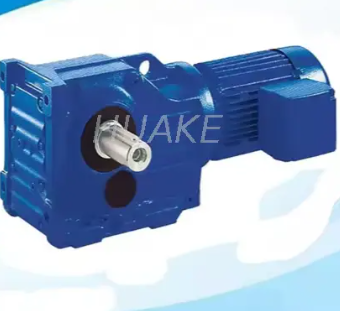
A K Series Bevel Gear Reducer is usually worth considering when efficiency and continuous duty are major priorities.
Long operating hours increase the value of lower power losses.
This applies to conveyors and production systems.
It also applies to packaging and material handling lines.
K Series designs can support demanding industrial applications.
HUAKE lists up to 200 kW on its K87 product page.
Final power capacity still depends on model and ratio.
Never apply the maximum value to every size.
Higher efficiency can reduce wasted power.
This matters when equipment runs every day.
Buyers should compare lifecycle energy cost.
Do not focus only on purchase price.
K Series reducers provide several mounting arrangements.
This makes them useful in machine integration projects.
For smaller systems, HUAKE's KA47 offers a compact right-angle design.
View the HUAKE KA47 Spiral Bevel Gear Reducer
A worm gearbox should not be dismissed.
It solves several practical transmission problems well.
Worm gearing can provide large speed reduction in a compact assembly.
This can simplify machine layout.
HUAKE's RV40 page lists single-stage ratios from 1/7.5 to 1/100. It also lists larger combined ratios for double-stage arrangements.
Energy losses matter less when a machine runs infrequently.
Purchase cost and installation space may become more important.
A worm gearbox can therefore remain economical.
Some worm systems provide useful resistance to reverse motion.
However, this characteristic requires verification.
It should never replace a certified brake in safety-critical systems.
Retrofit projects often have fixed mounting dimensions.
Changing gearbox technology may require new shafts and brackets.
Modification cost can outweigh energy savings.
HUAKE provides a dedicated [Worm Gear Reducers] Worm Gear Reducers category, including NMRV and S Series options.
Start with the machine requirements.
Do not begin with gearbox price.
Record:
Motor power
Input speed
Required output speed
Continuous torque
Peak torque
Required ratio
Daily operating hours
Mounting position
Ambient temperature
Available installation space
Then compare both technologies under identical conditions.
| Selection Priority | More Suitable Direction |
|---|---|
| High continuous efficiency | K Series bevel reducer |
| Lower thermal loss | K Series bevel reducer |
| Long daily runtime | K Series bevel reducer |
| Compact large reduction | Worm gearbox |
| Intermittent operation | Worm gearbox may fit |
| Existing worm-drive retrofit | Worm gearbox may simplify installation |
| Flexible modular mounting | Check K Series configurations |
| Self-locking requirement | Verify specific worm design |
Finally, compare total ownership cost.
Include motor energy, maintenance, oil, replacement parts, and installation work.
The lowest gearbox purchase price may not create the lowest lifetime cost.
Tip: Ask the supplier for efficiency data at your actual ratio and operating torque.
A K Series Bevel Gear Reducer usually offers higher efficiency, lower heat, and better continuous-duty performance. Worm gearboxes remain useful for compact ratios and intermittent applications.
HUAKE Gearbox provides bevel and worm gearbox solutions for industrial drives. Its product range supports flexible mounting, reliable torque transmission, and application-specific selection for demanding equipment.
A: A K Series Bevel Gear Reducer provides efficient right-angle power transmission using helical and bevel gears.
A: A K Series Bevel Gear Reducer usually has lower sliding losses and higher gearbox efficiency.
A: A K Series Bevel Gear Reducer suits continuous duty, lower heat, and energy-efficient right-angle drives.
A: A worm gearbox can suit compact, high-ratio, intermittent applications.
A: Ratio, load, speed, lubrication, temperature, and gear design affect right angle gearbox efficiency.
A: Overloading, friction, poor lubrication, or incorrect mounting can increase heat.


