
- All
- Product Name
- Product Keyword
- Product Model
- Product Summary
- Product Description
- Multi Field Search


Views: 0 Author: Site Editor Publish Time: 2026-09-25 Origin: Site


Can a gearbox be sized correctly by motor power alone?
An HB Industrial Gearbox must also match torque, ratio, duty, and mounting conditions.
In this article, you will learn how to calculate these factors and select a suitable gearbox for heavy-duty applications.
Correct HB industrial gearbox sizing should begin at the driven machine.
Do not begin by selecting a catalogue model. First define what the gearbox must actually transmit.
Start by identifying the driven equipment.
It may be a conveyor, crusher, mixer, mill, hoist, or crane. These machines can create very different load patterns.
Record the normal operating load first.
Then identify starting torque, peak torque, shock loading, and braking events. Also record operating hours and starts per hour.
A conveyor may run under relatively stable torque.
A crusher may experience sudden impact loads. A lifting system can also create high startup demands.
This explains why identical motors can require different gearbox sizes.
H/B heavy-duty gearboxes are commonly applied in mining, cement, metallurgy, lifting, and material-handling equipment.
Output torque is one of the most important sizing parameters.
Use this common relationship:
Torque (Nm) = 9550 × Power (kW) ÷ Speed (rpm)
Suppose a driven shaft needs 75 kW at 100 rpm.
Its theoretical operating torque is approximately:
9550 × 75 ÷ 100 = 7,162.5 Nm
This value represents operating torque only.
You must still consider peak loads and the required service factor.
Design Torque = Operating Torque × Service Factor
The correct service factor should come from the gearbox manufacturer's selection tables.
It depends on load type, running hours, starting frequency, inertia, and shock severity.
Tip: Never approve a gearbox using calculated running torque alone.
Next, calculate the required HB industrial gearbox ratio selection.
Use:
Gear Ratio = Input Speed ÷ Required Output Speed
For example, assume the motor runs at 1,500 rpm.
If the machine requires 100 rpm:
Gear Ratio = 1500 ÷ 100 = 15
The theoretical requirement is therefore about 15:1.
You should then review available standard ratios.
If the nearest catalogue ratio is 15.5, calculate the actual output speed again:
Output Speed = 1500 ÷ 15.5 ≈ 96.8 rpm
Confirm whether this result suits the driven equipment.
A higher ratio generally lowers output speed. It also increases available output torque.
However, ratio should never be selected independently from torque and thermal limits.
Now check motor power against gearbox capacity.
A gearbox rated for sufficient torque may still have input-power limits.
The rating can also change at different input speeds.
Do not assume the maximum advertised power applies to every model.
The HUAKE H&B Series High Power Reducer covers both H and B configurations.
HUAKE lists H Series ranges of 4–5000 kW. The stated torque range is 2–900 kNm. The ratio range is 1.25–450.
For B Series units, HUAKE lists 2.8–3000 kW. It states 5.8–900 kNm torque and ratios from 5–400.
These ranges describe the overall series.
They should not replace model-specific selection data.
The HB gearbox service factor selection accounts for real operating severity.
A smooth continuous load differs from repeated shock loading.
Consider:
Daily operating hours
Starts per hour
Reversing frequency
Acceleration
Braking
Shock loads
Driven-machine inertia
A gearbox with sufficient nominal torque can still be undersized.
This happens when the actual service factor is ignored.
Service-factor definitions can also differ between gearbox manufacturers.
Use the selected supplier's engineering tables during final sizing.
Next, identify the transmission arrangement.
H Series gearboxes generally use parallel-shaft helical gear pairs. B Series units use helical gears and spiral bevel gears for right-angle transmission.
HUAKE's H Series H1SH5 gearbox supports several input and output configurations.
Available outputs include solid shafts, hollow shafts, splined shafts, and shrink-disc arrangements.
For right-angle layouts, the B Series B3HH6 gearbox uses helical and spiral bevel gear pairs.
Mechanical torque capacity is not the final check.
Gearboxes generate heat during continuous operation.
Input speed, ambient temperature, duty time, oil level, and cooling conditions all affect temperature.
Mounting position also changes lubricant distribution.
Check:
Oil quantity
Lubrication method
Breather location
Drain position
Cooling requirement
Maintenance access
A mechanically adequate gearbox may still be thermally undersized.
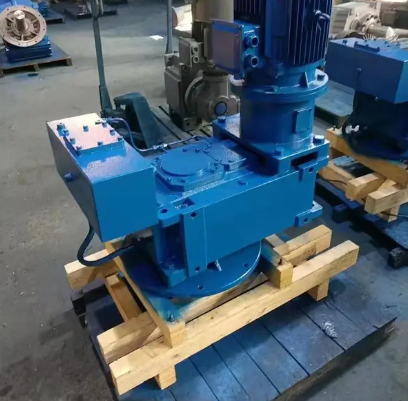
Lower output speed creates higher torque for the same transmitted power.
This relationship explains why heavy-duty reducers achieve large output torque.
Always calculate torque at the driven shaft.
Do not use only motor torque.
Many industrial machines do not operate under constant loads.
Conveyors may start fully loaded.
Crushers can experience material jams. Hoists must accelerate suspended loads.
Record these transient conditions separately.
The gearbox must withstand both continuous and permitted peak torque.
Once operating torque is known, apply the verified service factor.
For example:
Operating torque: 7,000 Nm
Illustrative service factor: 1.5 [Needs verification]
Design torque:
7,000 × 1.5 = 10,500 Nm
The 1.5 value is only an example.
Use the manufacturer's actual factor for final selection.
Torque is not the only force acting on the output shaft.
Belts and sprockets can create radial loads.
Some gears and driven systems create axial thrust.
These forces affect shaft and bearing life.
Always verify permissible external shaft loads.
Start with the actual motor speed.
Then define the required machine speed.
Divide input rpm by target output rpm.
This gives the theoretical reduction ratio.
Gearbox catalogues usually provide standard ratios.
Select the nearest suitable ratio.
Then recalculate actual output speed.
The selected ratio must satisfy both process speed and torque requirements.
Very large ratios may require additional reduction stages.
More stages can increase gearbox size and complexity.
They may also affect efficiency and heat generation.
Use the supplier's verified ratio chart before final approval.
After choosing the final ratio, recalculate torque.
Efficiency should also be considered.
Estimated Output Torque ≈ 9550 × Output Power ÷ Output Speed
Do not mix maximum catalogue values from different gearbox sizes.
A 75 kW motor does not always require the same reducer.
One application may run at 500 rpm output.
Another may require only 30 rpm.
Their output torque requirements will differ greatly.
Verify the permitted input power at the actual input speed.
Also check the selected ratio and gearbox size.
Motor kW should therefore be one selection parameter, not the only parameter.
Some energy is lost through gearing and bearings.
Use:
Output Power ≈ Input Power × Gearbox Efficiency
Final efficiency should come from model-specific technical documentation.
A larger motor can expose the gearbox to greater overload.
Check the coupling and driven shaft as well.
High-inertia starts need additional attention.
Tip: Increasing motor power does not automatically increase gearbox safety margin.
H Series units suit parallel-shaft transmission.
B Series configurations support right-angle transmission.
Choose the arrangement that matches the machine layout.
Mounting orientation should be defined before ordering.
Check shaft height and foundation space.
Also verify coupling position and service access.
Changing orientation changes internal oil distribution.
Bearings and gears may sit at different oil levels.
Breather and drain positions may also need adjustment.
Do not rotate an installed gearbox without reviewing lubrication requirements.
Vertical mounting or high-speed operation can change heat behavior.
Fans or external cooling may be needed in demanding applications.
Always verify thermal capacity under actual operating conditions.
Pulleys, sprockets, drums, and gears create additional shaft forces.
Compare them against bearing and shaft limits.
Continuous operation creates different thermal demands from intermittent use.
Starts and stops also increase mechanical stress.
Include reversing and braking in the duty description.
Dust, moisture, heat, cold, and corrosion can affect gearbox life.
Specify indoor or outdoor operation.
Also report ambient temperature and contamination levels.
Some applications require low vibration or stable positioning.
HUAKE states that its HB gearbox uses ground cylindrical and spiral bevel gears. Its housing design also targets lower noise and improved heat dissipation.
Model-specific performance should still be confirmed before procurement.
Motor power does not define output torque.
Always include speed and load calculations.
A gearbox can survive steady operation but fail during startup.
Check acceleration, braking, and shock loads.
A close catalogue ratio can still change machine speed.
Always calculate the actual rpm again.
Mounting affects more than installation geometry.
It influences lubrication, cooling, and maintenance access.
A complete enquiry allows faster and more accurate selection.
Provide:
| Category | Required Information |
|---|---|
| Motor | Power, rpm, motor type, starting method |
| Machine | Conveyor, crusher, mill, hoist, mixer, or other equipment |
| Load | Running torque, starting torque, peak torque |
| Speed | Required output rpm |
| Duty | Daily hours, starts per hour, reversing |
| Installation | Horizontal, vertical, parallel, or right angle |
| Shaft | Solid, hollow, splined, shrink-disc requirement |
| Environment | Temperature, dust, moisture, outdoor conditions |
| Cooling | Natural, fan, or external cooling requirement |
You can also review HUAKE's complete gearbox product range before sending an enquiry.
Its product portfolio includes helical, bevel, planetary, worm, cycloidal, and cylindrical reducers.
| Sizing Item | What to Confirm |
|---|---|
| Motor power | Rated kW |
| Input speed | Motor rpm |
| Output speed | Required machine rpm |
| Ratio | Input rpm ÷ output rpm |
| Operating torque | Continuous driven load |
| Peak torque | Startup and shock loads |
| Service factor | Manufacturer-specific value |
| Mounting type | Parallel, right-angle, horizontal, vertical |
| External loads | Radial and axial forces |
| Thermal condition | Ambient temperature and duty |
| Lubrication | Oil type, quantity, orientation |
| Shaft configuration | Solid, hollow, splined, shrink disc |
Correct HB Industrial Gearbox sizing requires torque, ratio, power, service factor, and mounting checks. Proper selection helps reduce overload, overheating, and premature wear.
HUAKE Gearbox provides heavy-duty H and B Series industrial gearboxes. Its broad ratio, torque, power, and mounting options support reliable transmission for mining, cement, lifting, and other demanding applications.
A: An HB Industrial Gearbox provides heavy-duty speed reduction and torque transmission for industrial machinery.
A: Size an HB Industrial Gearbox using torque, ratio, power, service factor, and mounting requirements.
A: It adjusts gearbox sizing for shock loads, operating hours, starts, and duty severity.
A: Divide motor input speed by the required output speed.
A: Price varies by torque capacity, ratio, power rating, mounting type, and customization.
A: Common causes include overload, poor lubrication, incorrect mounting, or insufficient cooling.


